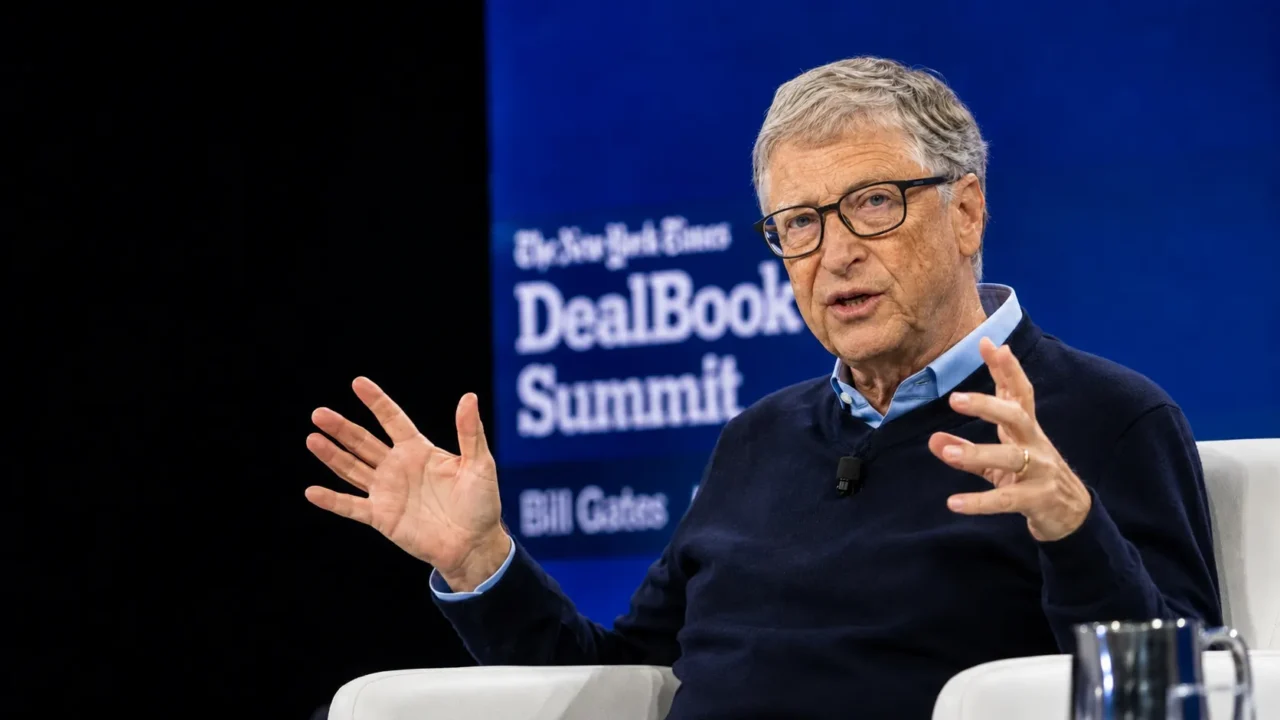

Bill Gates is urging governments to prepare more aggressively for the disruption artificial intelligence could bring to jobs, security and social life. In a new essay on the AI transition, the Microsoft co-founder argues that AI could produce major gains in health, agriculture, education and public services, but warns that those gains will not be shared fairly without stronger safeguards and a broader transition plan.
The essay represents a significant increase in the urgency and prominence Gates gives to AI’s immediate risks. He still expects the technology to deliver substantial benefits, but says governments, companies and communities are not preparing quickly enough for the disruption that could arrive alongside them.
The short answer: Gates wants stronger national and international AI governance, protection for workers and children, selected roles kept for people under his “Human Reserved” idea, and taxes on AI tokens and robots to slow excessive automation and help fund retraining and social protections.
What is Bill Gates warning about?
Gates focuses on three broad areas: employment, safety and security, and the effect of AI on children and human relationships. He argues that AI is unusual because it can substitute for parts of human cognition and can spread quickly through devices and software people already use.
| Risk area | What Gates is concerned about | Why it matters |
| Jobs | AI and robotics could permanently remove many entry- and mid-level roles and later affect more physical work. | The disruption may be structural rather than a temporary economic cycle. |
| Safety and security | More capable systems could make hacking, fraud, disinformation and biological threats easier to scale. | The same capabilities that help defenders and researchers can also empower bad actors. |
| Children and society | Heavy reliance on AI companions and automated systems could affect learning, social development and human relationships. | Gates argues that social protections need to evolve alongside the technology. |
What safeguards does Gates want governments to consider?
Gates is not calling for a blanket ban on AI research. His proposals focus on managing the transition while development continues. In the essay, he calls for stronger domestic and international frameworks, policies to soften large-scale job displacement, and public debate over where human work should be protected.
- Stronger national and international frameworks for AI governance and safety.
- Policies that help workers retrain and strengthen the social safety net as automation changes employment.
- Reserving selected jobs or tasks for people, an idea Gates calls “Human Reserved.”
- Taxing AI tokens and robots to reduce tax incentives that currently favour automation and to raise money for retraining and a stronger safety net.
What does “Human Reserved” mean?
“Human Reserved” is Gates’s name for jobs or tasks that society may decide should remain primarily human even when machines could technically perform them. He points to areas such as caregiving, health, education and mental health, where empathy, responsibility and human connection can matter as much as efficiency.
The idea is not presented as a fixed list. Gates says the boundaries would vary by country and could change over time as societies decide what should be automated and what should remain in human hands.
Why does Gates support taxes on AI tokens and robots?
Gates argues that current tax rules can make replacing workers with machines financially attractive. Employers pay payroll taxes when they hire people, while robots and other capital investments can receive different tax treatment. He therefore proposes taxes on AI tokens and robots, rather than a vague tax on every AI system.
His stated goal is twofold: slow the rush away from human labour and raise money for retraining and a stronger social safety net. He also says such taxes should be targeted so they do not unnecessarily slow beneficial uses of AI, including cheaper medicine and education.
Does Bill Gates want AI development to slow down?
His position is more nuanced than a call for a pause. Gates says he would probably support a credible global plan that slowed AI progress, but he does not expect such a plan to emerge because economic and geopolitical incentives push countries and companies to keep advancing.
That leaves governments with the harder task of building safeguards while the technology continues to improve. Gates argues that waiting until unemployment, security failures or social harms become obvious would leave policymakers reacting too late.
Why is Gates more worried about AI now?
Gates has discussed automation risks and robot taxation before, so this is not a complete reversal of his earlier position. What has changed is the urgency he gives to near-term risks. The Washington Post reported that his concern intensified as AI advanced faster than he expected in software coding and cyber capabilities, while progress on regulation and harm reduction lagged behind.
Gates acknowledged that he retains financial ties to the technology sector and works with Microsoft and other AI companies through the Gates Foundation, while saying his goal is to ensure the technology benefits people more broadly.
Gates still sees major benefits from AI
The warning is not a rejection of artificial intelligence. Gates continues to highlight its potential in healthcare, disease prevention, agriculture, education, government services and clean energy, especially in places where skilled workers and public resources are limited.
His central argument is about distribution and preparation. If AI mainly rewards already wealthy companies and countries, he fears it could widen existing gaps. If governments and institutions build stronger rules, worker protections and access, he believes the technology could instead improve life across income levels.
Why this warning matters
Gates is not running an AI company day to day, but his intervention carries weight because of his role in the personal-computing era, his continuing technology investments and his work through the Gates Foundation. His essay adds another high-profile voice to the debate over whether AI governance is keeping pace with rapidly improving systems.
The practical debate is no longer simply whether AI will change work and public life. It is about how quickly that change arrives, which risks governments should treat as urgent, and how societies can preserve the benefits of innovation without leaving workers and vulnerable groups to absorb the costs alone.
Key questions
What is “Human Reserved”?
It is Gates’s proposal that some jobs or tasks remain reserved for people even when automation is technically possible, especially where human connection or difficult worker transitions make full automation undesirable.
Why does Gates support an AI and robot tax?
He proposes taxes on AI tokens and robots to reduce incentives for rapid worker replacement and to help fund retraining and a stronger social safety net.
The AI debate is increasingly about how to manage the transition
Gates still sees AI as a technology capable of major social and economic gains. His latest essay puts far more emphasis on the possibility that those gains could arrive alongside permanent job losses, new security threats and social disruption.
His message is that governments and institutions need to make choices before those pressures become harder to reverse. The technology is moving quickly, and Gates argues that the policy response needs to move with greater urgency.
Updated: September 10, 2026
Recommended
Summarize this article
Open this story in your preferred AI assistant. The prompt is copied as a fallback.

About the author
FTL Editor
"FTL Editor" is Factelle's house byline for stories reported and verified by our editorial desk rather than a single named contributor. Every fact is checked against a primary or wire source, campaign/company claims are labeled as such rather than presented as verified, and articles are updated with a visible timestamp as new information comes in. Corrections are flagged directly in the article per our Corrections Policy.