
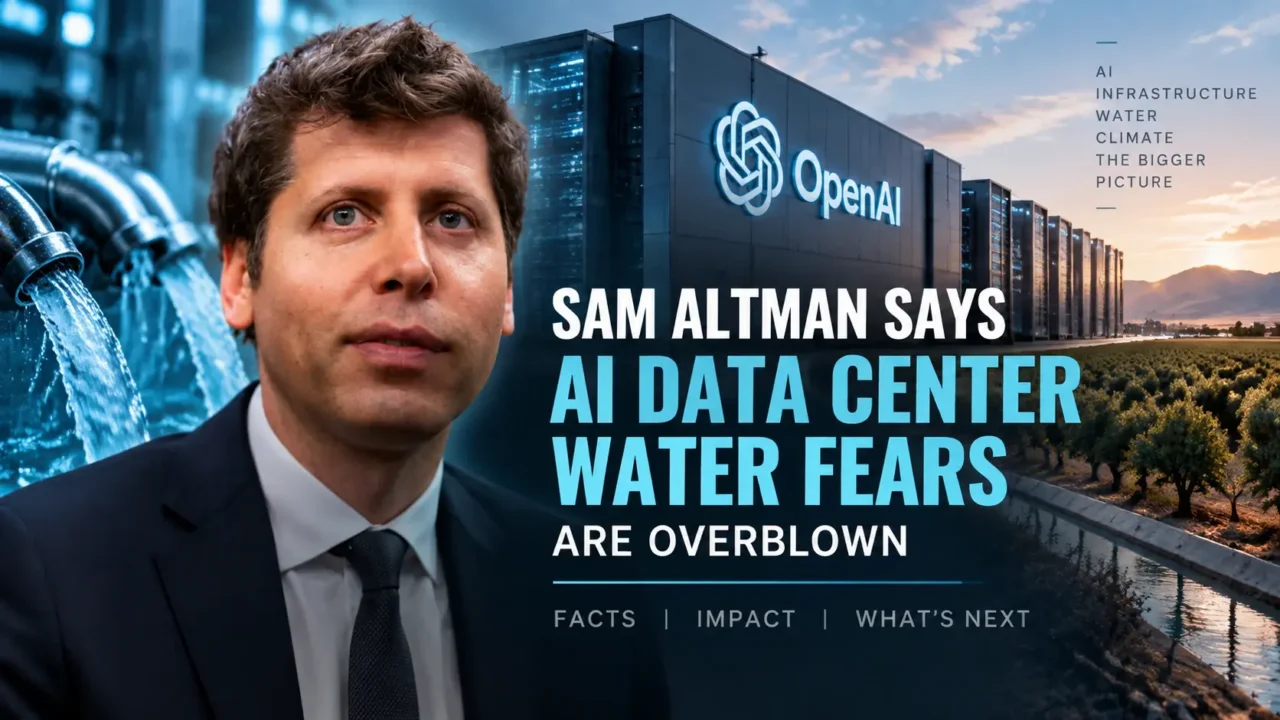

Sam Altman and the growing debate around AI data centers, water consumption, and the environmental impact of artificial intelligence infrastructure.
OpenAI Chief Executive Officer Sam Altman has pushed back against concerns over artificial intelligence’s water footprint by comparing ChatGPT usage with agricultural water consumption. However, the accuracy of that comparison depends on how researchers define and measure water use.
During the Sources podcast, Altman said that producing one California almond uses roughly the same amount of water as 38,000 ChatGPT queries. He noted that the calculation was based on memory and may not be exact. Recalling figures from memory during the interview, “Altman argued that some public perceptions of AI water use rely on older assumptions about data center cooling, noting that modern hyperscale data centers consume comparable on-site water to standard commercial office buildings.
Altman’s statement marks a direct attempt to rewrite the narrative surrounding generative AI’s natural resource footprintEarlier 2023 research estimated that a 500-milliliter bottle of water could correspond to roughly 20 to 50 ChatGPT questions and answers under certain conditions. The estimate was a model-based calculation, not a universal measurement for every AI interaction
EXECUTIVE SUMMARY: Sam Altman’s almond comparison highlights one possible way to compare agricultural and AI water use. However, researchers note that the result changes depending on whether water use is measured through direct irrigation, full water footprint accounting, direct data center cooling or broader energy-related consumption.
Deconstructing the Math: Almonds, Queries, and Milliliters
To evaluate whether Altman’s claim holds up under mathematical scrutiny, independent researchers and environmental analysts have cross-referenced published agricultural data with revised AI power consumption models.
On the compute side, using a higher almond water-footprint estimate produces a figure close to Altman’s 0.32 milliliter estimate. However, using lower almond estimates produces a significantly different result, showing why the comparison depends on the assumptions used. Other AI water estimates exist, but they are not directly interchangeable because they may use different models, hardware, response lengths, locations and accounting boundaries.
The Evolution of Data Center Cooling Technology
A primary reason behind the discrepancy between public perception and current operational reality involves the rapid technological evolution of data center cooling infrastructure, a dynamic explored in detail by Data Center Knowledge and environmental coverage from DW.
From Open Evaporative Towers to Closed-Loop Systems
Historically, early hyperscale data centers relied heavily on evaporative cooling towers. In these traditional systems, water is continuously evaporated into the atmosphere to dissipate heat generated by server racks. While highly energy-efficient, evaporative cooling consumes substantial volumes of fresh water, with up to 85 percent of withdrawn water lost to the atmosphere rather than returned to local watersheds.
However, major cloud providers and AI infrastructure developers have aggressively shifted toward closed-loop dry cooling and direct-to-chip liquid cooling systems in newer builds. According to industry sustainability reports, closed-loop systems recirculate the same treated coolant continuously through a sealed system, requiring initial water filling but consuming virtually zero operational water on an ongoing basis.
Free-Air Cooling and Hybrid Infrastructure
Furthermore, modern facilities built in temperate regions utilize ambient outside air for natural cooling. Advanced facilities operated by major global infrastructure providers have achieved Water Usage Effectiveness (WUE) metrics as low as 0.03 liters per kilowatt-hour, over 98 percent lower than the United States national data center average of 1.8 liters per kilowatt-hour.
Comparative Overview: Cooling Technologies and Environmental Trade-offs
| Cooling Technology | On-Site Water Use | Power Demand | Environmental Trade-off |
| Traditional Evaporative | High (300k–1M gal/day) | Lower Energy Overhead | High direct local water loss via evaporation |
| Closed-Loop Dry Cooling | Minimal to Near-Zero | Higher Energy Overhead | Saves local water but increases electricity grid draw |
| Direct-to-Chip Liquid | Very Low (Sealed Loop) | Optimized High-Density | Requires capital investment and specialized fluids |
| Hybrid Free-Air Cooling | Low / Seasonally Variable | Highly Efficient | Location-dependent; requires moderate ambient climates |
Why the Almond vs. AI Comparison Remains Complex
While Altman’s per-query math is technically sound for modern closed-loop setups, environmental economists and policy analysts caution that direct single-unit comparisons can obscure larger systemic challenges.
1. On-Site vs. Indirect Water Footprints
Focusing exclusively on direct on-site data center water usage omits indirect water footprint factors. Electric power generation, specifically thermoelectric power plants relying on coal, natural gas, or nuclear energy, requires massive volumes of water for cooling. When factoring in grid-level power generation, indirect water consumption adds an estimated 1 to 10 milliliters per prompt. Additionally, manufacturing advanced semiconductor microchips requires ultra-pure water during wafer fabrication.
2. Aggregate Local Scale vs. Individual Unit Demand
No single ChatGPT prompt strains local resources in isolation. However, aggregate compute demand across millions of daily user interactions, large language model training runs, and gigawatt-scale hyperscale campuses creates concentrated demand in specific regional watersheds. While almond orchards spread across agricultural acreage in California, data centers concentrate electrical and thermal loads within individual municipalities.
3. The Power-Water Trade-Off
In data center design, water and electricity exist in a direct trade-off. Transitioning away from evaporative cooling to zero-water dry cooling protects local municipal water supplies but increases total electrical power consumption. This shift places additional stress on local electrical power grids, indirectly impacting regional carbon emissions unless powered entirely by dedicated renewable energy sources.
Frequently Asked Questions
Does a single ChatGPT search query really use a bottle of water?
No. There is no single universal water-use number for every ChatGPT query. Estimates depend on the model, hardware, location, cooling system and whether researchers measure direct or indirect water consumption.
How much water do modern data centers consume daily?
Water consumption varies significantly by facility size and cooling setup. A medium enterprise facility using evaporative cooling consumes around 300,000 gallons per day, whereas modern facilities employing closed-loop dry cooling consume negligible amounts of operational water on site.
Why are data centers moving away from evaporative water cooling?
Data center operators are shifting toward closed-loop and dry cooling systems to reduce environmental impact, comply with local municipal regulations in water-stressed regions, and ensure operational resilience against climate-induced drought conditions.
Conclusion: Balanced Perspective on AI Infrastructure
Sam Altman’s almond comparison shows why AI water discussions require careful measurement. The comparison may be directionally useful, but it does not represent a universal water cost for every ChatGPT interaction.
Recommended
Summarize this article
Open this story in your preferred AI assistant. The prompt is copied as a fallback.

About the author
FTL Editor
"FTL Editor" is Factelle's house byline for stories reported and verified by our editorial desk rather than a single named contributor. Every fact is checked against a primary or wire source, campaign/company claims are labeled as such rather than presented as verified, and articles are updated with a visible timestamp as new information comes in. Corrections are flagged directly in the article per our Corrections Policy.