
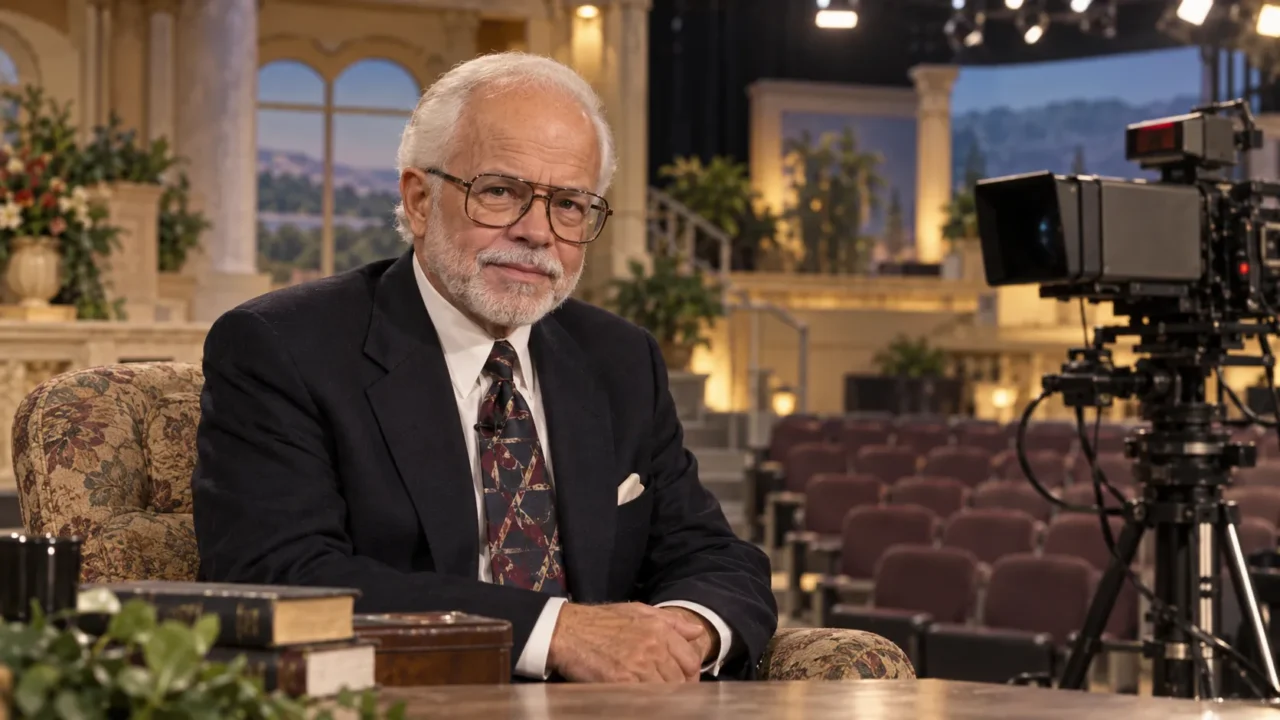

The television pastor built one of America’s best-known religious broadcasting brands, went to prison for fraud and later returned to the air.
Jim Bakker, the American televangelist who built the PTL Club into a television ministry empire before fraud convictions sent him to federal prison, died on Monday, October 5, 2026. He was 86. His second wife, Lori Bakker, announced his death. A cause was not immediately disclosed.
The announcement and basic details were reported in NBC News coverage of Jim Bakker’s death. Bakker’s death closes a public life that cannot be described only as a broadcasting success or only as a criminal downfall. His career helped define the scale of American televangelism, while the collapse of PTL became one of its most enduring warnings about money, celebrity and weak financial oversight.
Jim Bakker’s life and career at a glance
| Period | What happened | Why it mattered |
| 1960s to early 1970s | Bakker and Tammy Faye worked in Christian television, including roles connected with CBN and TBN. | They helped shape an entertainment-led style of religious broadcasting. |
| 1974 to 1987 | The PTL Club expanded into a major television ministry and fundraising operation. | The programme made the couple national figures and supported a wider commercial ministry. |
| 1980s | PTL developed Heritage USA, a Christian resort and theme park in South Carolina. | It showed how far televised fundraising could extend beyond a studio ministry. |
| 1989 | A federal jury convicted Bakker on 24 fraud and conspiracy counts. | The case exposed financial practices tied to PTL fundraising and lifetime partnerships. |
| 1994 | Bakker left federal custody after serving nearly five years. | His original 45-year sentence had been overturned and later reduced to eight years. |
| 2003 onward | Bakker returned with The Jim Bakker Show in Missouri. | His second television career focused more heavily on prophecy and survival products. |
| 2026 | Lori Bakker announced his death at age 86. | The cause of death was not immediately released. |
How the PTL Club became a television empire
Bakker and his first wife, Tammy Faye, became familiar faces to American Christian television audiences during the medium’s rapid expansion. Their on-screen style was less formal than traditional pulpit broadcasting. The PTL Club mixed preaching, music, interviews, fundraising appeals and emotional conversation in a format designed to feel personal inside viewers’ homes.
That approach helped PTL grow into much more than a programme. Donations supported a satellite network and Heritage USA, the ministry’s large resort complex near Fort Mill, South Carolina. The development included hotels, attractions and worship spaces. At its height, the ministry reached millions of viewers and turned Jim and Tammy Faye into religious celebrities.
A separate Fox News account of Bakker’s PTL Club career described the scale of his rise and his association with Tammy Faye, whose personality, singing and distinctive public image became inseparable from the programme. Their partnership helped PTL stand out in a crowded television market, but it also tied the ministry’s finances and reputation closely to the couple’s public lives.
The scandal that ended Bakker’s first ministry
PTL began to unravel in 1987 after disclosures involving a sexual encounter between Bakker and church secretary Jessica Hahn, along with a payment made to keep the matter private. Hahn said the encounter was not consensual. Bakker resigned from the ministry, and the public scandal opened the door to wider scrutiny of PTL’s finances.
Federal prosecutors focused on the sale of lifetime partnerships connected with lodging at Heritage USA. Supporters paid money after being told the partnerships would provide annual hotel stays, but the ministry sold far more memberships than the available accommodation could support. Prosecutors argued that donated and partnership funds were misused while the promised facilities were not delivered at the represented scale.
In 1989, Bakker was convicted on 24 counts involving mail fraud, wire fraud and conspiracy. He initially received a 45-year federal sentence and a $500,000 fine. An appeals court upheld the convictions but ordered resentencing after finding a problem with the sentencing judge’s remarks. The prison term was later reduced to eight years, and Bakker was released in 1994 after serving nearly five years.
Prison, divorce and a public attempt at repentance
The collapse cost Bakker his ministry, fortune and marriage. Tammy Faye divorced him in 1992 while he was incarcerated and later married Roe Messner. She died of colon cancer in 2007. Bakker later wrote about his fall in the book I Was Wrong, presenting prison as a period in which he reconsidered prosperity teaching and his earlier approach to ministry.
His effort to frame the later years as repentance remained contested. Supporters saw his return as evidence of religious restoration. Critics argued that the renewed ministry repeated familiar patterns by combining urgent spiritual messages with the sale of products and requests for financial support. Both views are central to understanding why his name continued to draw attention long after the original PTL network disappeared.
A second television career in Missouri
Bakker married Lori Beth Graham in 1998. The couple launched The Jim Bakker Show in 2003 and built a new ministry presence near Branson, Missouri. The programme brought him back to daily religious broadcasting, but its tone was different from the colourful PTL years. Episodes often focused on biblical prophecy, political anxiety, disasters and preparation for emergencies.
The comeback demonstrated that Bakker still understood the intimacy of television ministry. He spoke directly to an audience that viewed current events through a religious lens and sold food buckets, survival supplies and other products linked to emergency preparation. That model attracted committed viewers while reviving concerns about the line between pastoral messaging and commerce.
The Silver Solution case revived old concerns
Bakker faced renewed legal scrutiny during the early months of the COVID-19 pandemic after his programme promoted a product called Silver Solution. A guest suggested on air that the product could eliminate strains of coronavirus, even though it had not been proven to prevent or cure COVID-19.
Missouri authorities sued, and a 2021 settlement required refunds totalling about $156,000 for customers who had purchased or contributed to receive the product. The case did not recreate the scale of the PTL prosecution, but it reinforced the central criticism that followed Bakker for decades: religious trust and urgent claims could be used to support commercial sales without adequate evidence.
A legacy that shaped televangelism and public distrust
The New York Times obituary of Jim Bakker placed his death within the larger story of American religion, television and scandal. Bakker helped prove that a religious programme could operate as a national media brand, build attractions, sell memberships and create celebrity figures whose influence extended beyond the church audience.
The same career exposed the risks of concentrating spiritual authority, fundraising and business control in a small leadership circle. PTL supporters were not merely television viewers. Many believed their donations served a religious mission. The fraud case therefore carried a breach of trust that went beyond an ordinary failed business.
His influence can also be seen in the entertainment and documentary projects that revisited the Bakkers, particularly the story of Tammy Faye. Those portrayals sometimes treated her with greater sympathy while keeping Jim Bakker’s financial crimes and ministry practices at the centre of the collapse. The continuing interest shows how deeply the PTL era entered American popular culture.
What is confirmed about Jim Bakker’s death
Lori Bakker said her husband died on October 5 at age 86. The family did not immediately announce a cause or location of death. Bakker had suffered a stroke in 2020, but available reporting did not establish that the stroke caused his death. Responsible coverage should therefore avoid stating or implying a medical cause that the family has not confirmed.
Bakker is survived by Lori and a blended family. He and Tammy Faye had two children, and he and Lori adopted five children. His death ends a broadcasting career that stretched across more than six decades and contained extraordinary reach, criminal accountability, attempted rehabilitation and recurring controversy. Any fair obituary has to hold those facts together rather than allowing one chapter to erase the others.
Recommended
Summarize this article
Open this story in your preferred AI assistant. The prompt is copied as a fallback.

About the author
FTL Editor
"FTL Editor" is Factelle's house byline for stories reported and verified by our editorial desk rather than a single named contributor. Every fact is checked against a primary or wire source, campaign/company claims are labeled as such rather than presented as verified, and articles are updated with a visible timestamp as new information comes in. Corrections are flagged directly in the article per our Corrections Policy.