

A Malta Air Boeing 737-800 operating a Ryanair flight landed safely at Manchester Airport with 363 kg of fuel after three windshear go-arounds and an earlier Manchester diversion request that should have been accepted, UK investigators found. All 171 passengers and six crew members were uninjured, and no aircraft damage was reported.
What the AAIB investigation found
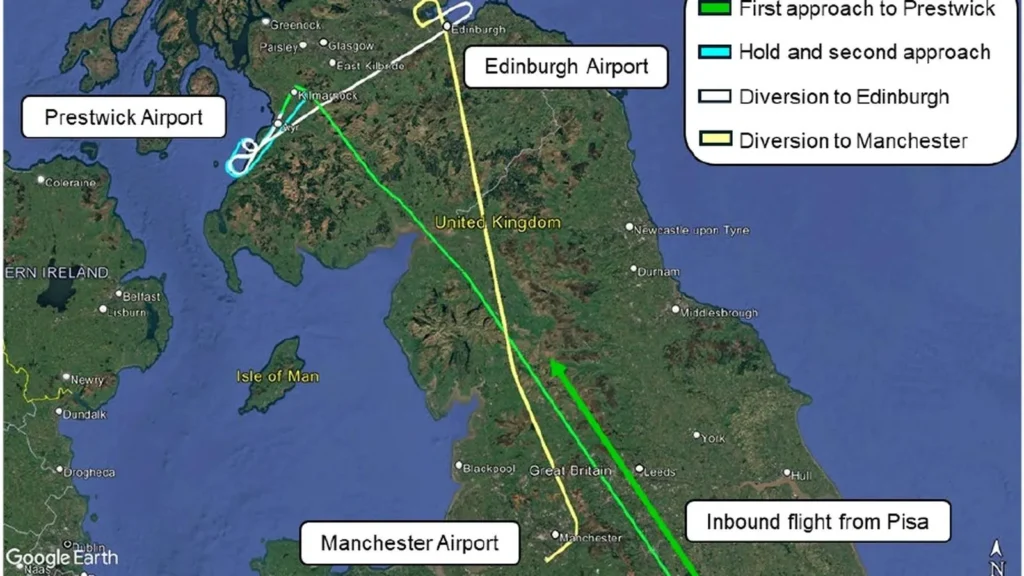
The Air Accidents Investigation Branch report says flight FR3418 left Pisa for Glasgow Prestwick on October 3, 2025, as Storm Amy brought strong winds across Scotland and northern England. The crew carried extra fuel because disruption was expected. Two windshear warnings forced go-arounds at Prestwick. The crew then asked to divert to Manchester, but the request was refused and the aircraft headed to Edinburgh instead.
A third windshear warning triggered another escape manoeuvre at Edinburgh. The pilots then declared a fuel MAYDAY and flew to Manchester, where the aircraft touched down at 19:51:30 UTC with 363 kg remaining. Its required final reserve was 1,101 kg. The investigation classified the event as a serious incident, not an accident.
| Incident detail | Verified information |
|---|---|
| Aircraft | Boeing 737-800, registration 9H-QBD |
| Operator and flight | Malta Air, operating Ryanair flight FR3418 |
| Route | Pisa to Glasgow Prestwick |
| People on board | 171 passengers and 6 crew |
| Landing | Manchester Airport, October 3, 2025 at 19:51:30 UTC |
| Fuel at touchdown | 363 kg, versus 1,101 kg final reserve |
| Outcome | No injuries and no reported damage |
How the flight moved from Prestwick to Edinburgh and Manchester
The first Prestwick approach ended after a windshear warning at 215 feet above ground. The crew entered a hold for about 20 minutes and watched whether another Boeing 737 could land. After that aircraft reported a 25-knot airspeed loss but landed, FR3418 made a second approach. Another warning sounded at about 50 feet, forcing the second go-around.
Company policy did not allow a third approach after two attempts had been abandoned because of windshear. Manchester had been the pilots’ preferred alternate from the planning stage, and its weather was more favourable. Prestwick air traffic control relayed, however, that Manchester could not accept the diversion. No reason was given to the pilots.
The fuel picture at each critical point
The aircraft had 11,671 kg shortly before taxiing at Pisa. The planned block fuel was 11,500 kg, including 1,937 kg of discretionary fuel after the pilots selected Manchester as the alternate and added extra fuel for the storm. That extra margin was significant, but repeated high-power escape manoeuvres, holding and the longer diversion sequence used it quickly. The report recorded combined fuel flow of about 120 kg per minute during go-around power.
| Flight point | Fuel recorded | Why it mattered |
|---|---|---|
| First Prestwick go-around | 4,608 kg | The crew still had 1,901 kg above the calculated minimum for Manchester. |
| Second Prestwick go-around | 3,515 kg | Manchester was requested, then refused. Edinburgh became the selected diversion. |
| Third go-around at Edinburgh | 2,164 kg | The crew expected a Manchester diversion to end below final reserve. |
| Fuel MAYDAY leaving Edinburgh | 2,036 kg | Estimated requirement for Manchester plus reserve was 2,800 kg. |
| Manchester touchdown | 363 kg | 738 kg below the 1,101 kg final reserve. |
| Before engine shutdown | 240 kg | Fuel continued to be used while taxiing to stand. |
Why Manchester rejected the first diversion
The AAIB did not establish exactly how the rejection decision was made because there was no record of the communication between Manchester Airfield Control and the handling agent. Its evidence shows that Manchester ATC received the request at 18:29 UTC. At 18:34, Airfield Control told ATC that the handling agent could not accept the flight. The refusal reached the pilots at 18:37, after their second missed approach.
That process did not match Manchester’s own diversion policy. The policy said Airfield Control should accept an aircraft when parking capacity was available and notify the handling agent, while the final decision remained with airport operations. Manchester had accepted 19 diversions during Storm Amy that day, and the operator already had ground handling at the airport. The AAIB concluded that a breakdown in communication within the airport led to a request that should have been accepted being refused.
Why the crew did not declare an emergency earlier
While waiting for the Edinburgh diversion to be approved, the pilots discussed both “minimum fuel” and a MAYDAY. They concluded their fuel state did not yet meet the company manual’s emergency criteria. “Minimum fuel” is not an emergency call. It tells air traffic control that the aircraft is committed to a particular airport and that further delay could cause it to land below planned reserve.
The operator later told investigators that an emergency could have been declared if the crew believed a safe landing at Edinburgh was not assured because of windshear. At the time of the decision, Edinburgh had reported strong winds and earlier go-arounds but no windshear. The AAIB therefore presented this as an issue of judgement under changing information, not a simple case of the pilots ignoring a known emergency.
The decision after the Edinburgh go-around
After the third warning, the aircraft had about 2,100 kg remaining. The crew estimated it would need 2,800 kg to reach Manchester and preserve final reserve. An initial mental estimate suggested 500 to 700 kg on arrival, but the flight management computer later showed 300 kg. That prediction prompted the fuel MAYDAY at 19:12:34 UTC.
The pilots believed another Edinburgh approach risked another warning. If they went around again, fuel could leave them with no diversion option. They chose Manchester because conditions were better and another go-around appeared less likely. The AAIB noted that Newcastle was closer and had lighter winds at the relevant time, but the crew did not consider it during the high-workload transit. It also noted that Manchester had been their preferred alternate from the outset, which may have influenced the decision.
FlightGlobal’s account and BBC reporting highlighted the refusal and the critically low landing fuel. The official report adds an important qualification: the aircraft landed safely, but investigators considered it unlikely that enough fuel remained for another go-around.
What happened to the windshear warning system
Investigators downloaded the flight data recorder, cockpit voice recorder and the Enhanced Ground Proximity Warning System. The manufacturer confirmed that the warning system operated as designed, with no recorded failure. Data showed that the trigger threshold was reached on all three approaches.
A windshear escape manoeuvre is designed to move the aircraft away from rapidly changing wind. It uses maximum thrust and a climb profile focused on clearing the hazard. The landing gear and flap settings are initially left unchanged, unlike in a normal go-around. This is why the warnings were treated as immediate safety events rather than alerts the crew could simply disregard.
Safety action taken after the serious incident
Manchester Airport reviewed its procedures and restated two points to stakeholders: diversions will be accepted when ground parking capacity is available, and a handling agent is notified but does not make the acceptance decision. Declared emergencies and medical diversions are always accepted under the policy cited by the AAIB.
The report did not publish a new safety recommendation to Boeing or identify an aircraft defect. Its central finding was operational: a communication breakdown wrongly blocked the preferred diversion, while worsening weather, three windshear escapes and subsequent decision-making reduced the fuel margin. The case shows how several individually manageable events can combine into a serious fuel situation.
Recommended
Summarize this article
Open this story in your preferred AI assistant. The prompt is copied as a fallback.

About the author
FTL Editor
"FTL Editor" is Factelle's house byline for stories reported and verified by our editorial desk rather than a single named contributor. Every fact is checked against a primary or wire source, campaign/company claims are labeled as such rather than presented as verified, and articles are updated with a visible timestamp as new information comes in. Corrections are flagged directly in the article per our Corrections Policy.