


Bob Mackie, the costume and fashion designer whose sequins, feathers, illusion fabrics and sharp comic instincts transformed the wardrobes of some of entertainment’s biggest stars, died Monday in Palm Springs, California. He was 87. The Associated Press reported that Mackie died of pneumonia, a cause later confirmed by his representative.
Mackie spent more than six decades turning clothing into performance. His work with Cher made red-carpet provocation part of modern celebrity culture. His costumes for Carol Burnett showed that wardrobe could also deliver a punch line. And his designs for Diana Ross, Tina Turner, Liza Minnelli, Elton John, Whitney Houston and many others helped establish a visual vocabulary for stage glamour that still echoes in contemporary pop tours and award shows.
What to know
- Mackie died on September 14, 2026, at age 87 in Palm Springs, California. His representative said the cause was pneumonia.
- He won nine Emmy Awards from 32 nominations and was inducted into the Television Academy Hall of Fame in 2002.
- His best-known collaborations included Cher and Carol Burnett, but his client list stretched across music, television, film and Broadway.
- He earned three Academy Award nominations for costume design and won the 2019 Tony Award for The Cher Show.
- His influence continued into a younger generation of performers, with stars including Taylor Swift and Miley Cyrus wearing Mackie designs or archival pieces.
A career built around performers, not trends
Mackie often described himself first as a costume designer, a distinction that helps explain why his work lasted beyond individual fashion cycles. His clothes were built for movement, lighting, television cameras and stage personalities. The goal was not simply to make a garment look luxurious on a hanger. It was to make the performer more legible from the back row of a theater or through a television screen.
The Television Academy credits Mackie with 32 Emmy nominations, nine wins and a 2002 Hall of Fame induction. His television career included The Carol Burnett Show, Cher specials, Mama’s Family and large-scale variety productions that demanded dozens of costumes under tight weekly schedules.
That production discipline became part of Mackie’s signature. He could create extravagant gowns for musical performances one day and visual jokes for sketch comedy the next. Carol Burnett’s famous curtain-rod dress from the “Went With the Wind!” parody remains one of the clearest examples: the costume is glamorous at first glance, absurd on closer inspection, and essential to the joke.
Bob Mackie career at a glance
| Career milestone | Why it matters |
|---|---|
| 1960s: Early Hollywood and television work | Worked for Jean Louis and Edith Head, and contributed to major television productions as costume design became a recognized specialty. |
| 1967: First Emmy win | Won for Alice Through the Looking Glass, part of the first Emmy recognition for costume design. |
| 1967-1978: The Carol Burnett Show | Designed across the show’s 11-year run, combining glamour with character and comedy. |
| 1970s onward: Cher collaboration | Helped create Cher’s unmistakable stage and red-carpet image through daring, heavily embellished designs. |
| Film: Three Oscar nominations | Nominated for Lady Sings the Blues, Funny Lady and Pennies from Heaven. |
| 2002: Television Academy Hall of Fame | Recognition of his long-term contribution to television costume design. |
| 2019: Tony Award | Won Best Costume Design of a Musical for The Cher Show. |
Cher became his most enduring creative partnership
No collaboration defined Mackie’s public image more than his work with Cher. Their partnership began in television and expanded into concerts, award shows and decades of public appearances. Mackie treated the singer’s body as part of the silhouette, using strategically placed beading, feathers, headdresses and sheer fabrics to create costumes that were theatrical without hiding the performer inside them.
The Wall Street Journal’s look back at Mackie’s career highlights the breadth of his work across generations, from Marilyn Monroe and Carol Burnett to Tina Turner, Whitney Houston, Elton John, Taylor Swift and Miley Cyrus.
His connection to Monroe came early. While working for designer Jean Louis, Mackie made the sketch for the sheer, crystal-covered dress Monroe wore when she sang “Happy Birthday” to President John F. Kennedy in 1962. Decades later, the drawing and the dress itself became part of Mackie’s origin story as a designer associated with moments that blurred fashion, celebrity and cultural memory.
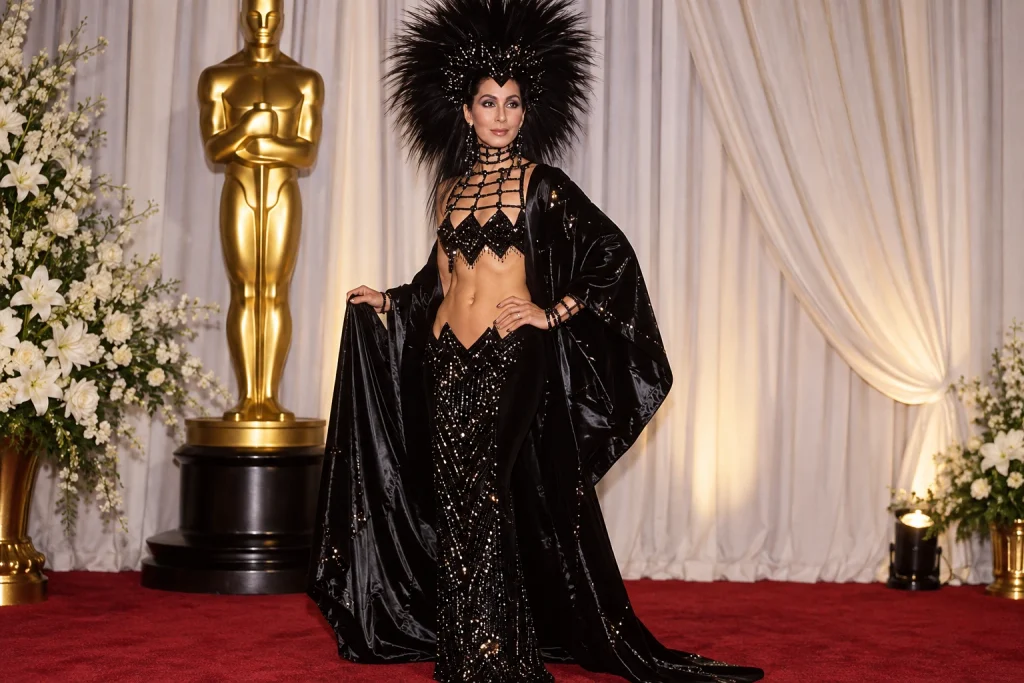
Cher and Bob Mackie built one of entertainment’s most influential designer-performer partnerships, shaping decades of stage and red-carpet style.
Carol Burnett showed the other side of Mackie
If Cher represented Mackie’s instinct for spectacle, Carol Burnett demonstrated his range. The Carol Burnett Show required costumes that could sell a character quickly, support physical comedy and still look deliberate under studio lights. Mackie designed for Burnett through the show’s full 11-season run and became part of its comedic machinery rather than simply its wardrobe department.
In its Hall of Fame tribute, the Television Academy described Mackie’s ability to approach costume as part of the production as a whole. Burnett’s curtain dress, complete with the rod still attached across the shoulders, became a lasting example of how costume itself could deliver a joke before a line was spoken.
Awards followed, but spectacle was only part of the achievement
The awards tell one version of Mackie’s career. Nine Emmys, three Oscar nominations and a Tony place him among the most decorated American costume designers of his era. The larger achievement was that viewers who knew little about costume design still learned to recognize his name and visual language.
Mackie also moved beyond one-off celebrity commissions. He created ready-to-wear collections, designed collectible Barbie dolls and extended his name into home products. Yet the work that defined him remained tied to performance. His most memorable designs were rarely quiet. They were meant to catch light, move with music, exaggerate a silhouette or help a character land a joke.
Bob Mackie’s death and the tributes that followed
Mackie’s death was announced on his official social accounts on September 14. CBS News and other outlets later reported that his publicist confirmed pneumonia as the cause of death. He died in Palm Springs, California.
The response reflected the unusual breadth of his career. Tributes came not only from the fashion world but also from television, music and theater, the industries in which his clothes had done much of their cultural work. For performers, Mackie was not simply the person who made the outfit. He helped define the version of themselves that audiences remembered.
A legacy built for the spotlight
Mackie spent his career proving that costume could be more than decoration. It could create a character, carry a joke, announce a star before she sang a note and turn a television appearance into an image remembered decades later. That is why his work continues to circulate long after the original shows, tours and red carpets ended.
For younger performers, his archive offers a blueprint for how clothing can function as part of a larger performance. For television history, his career documents the era when weekly variety shows gave costume departments an enormous creative canvas. And for fashion, his best-known looks remain a reminder that theatricality, precision and humor can coexist in the same garment.
Recommended
Summarize this article
Open this story in your preferred AI assistant. The prompt is copied as a fallback.

About the author
FTL Editor
"FTL Editor" is Factelle's house byline for stories reported and verified by our editorial desk rather than a single named contributor. Every fact is checked against a primary or wire source, campaign/company claims are labeled as such rather than presented as verified, and articles are updated with a visible timestamp as new information comes in. Corrections are flagged directly in the article per our Corrections Policy.