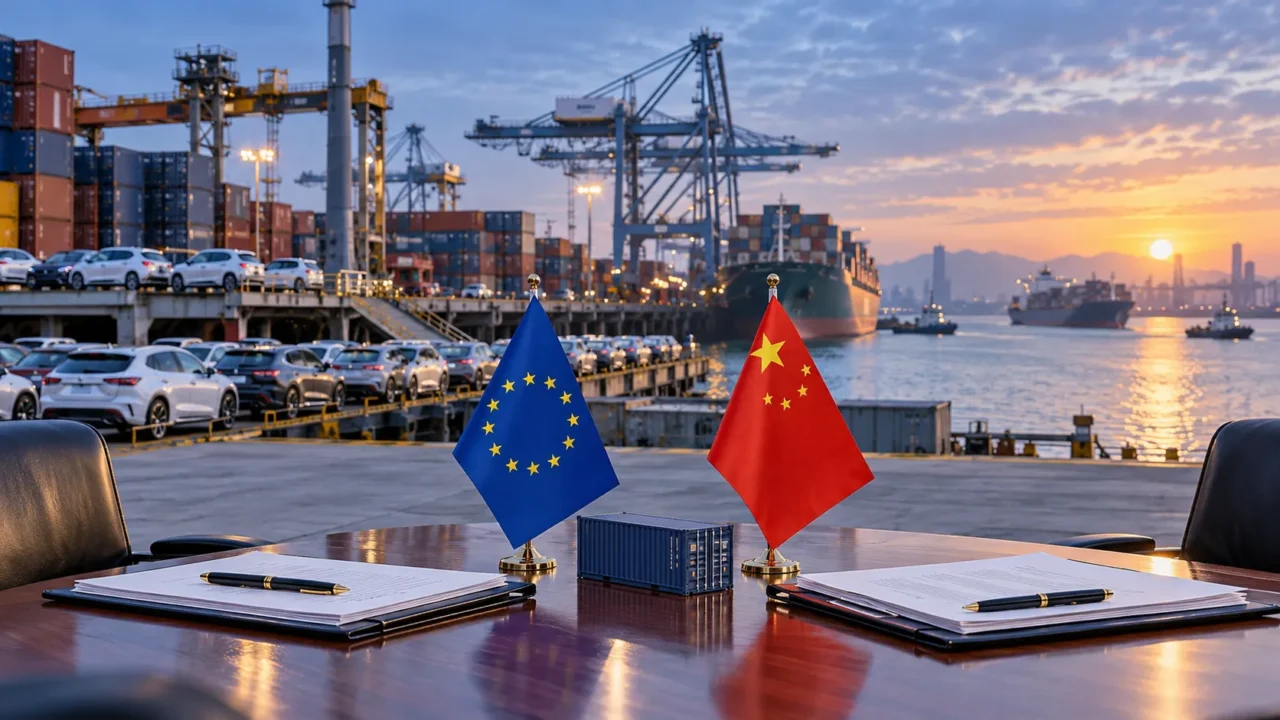

Beijing and Brussels are negotiating over a widening trade deficit, hybrid vehicles, critical minerals and market access. A broad pact remains uncertain, but narrower agreements could stop the dispute from escalating.
China and the European Union have entered a high-stakes round of trade talks in Beijing with a practical objective: produce enough progress to prevent their disputes from spreading into a wider economic confrontation. European Commissioner for Trade and Economic Security Maroš Šefčovič is due to meet Chinese Commerce Minister Wang Wentao on October 8 and 9.
The talks follow months of work under the new China-EU Trade and Investment Consultations. The Modern Diplomacy analysis of the possible economic deal argues that the current tensions could create an opening for a revised economic relationship. That remains a possibility, not an announced agreement.
A single comprehensive deal is unlikely to settle every grievance. The more realistic outcome would be a package of narrower commitments covering trade flows, export licensing, market access and specific products. Even limited agreements could matter if they are measurable and enforceable.
Why the trade relationship has reached a pressure point
The economic relationship remains large, but the balance has moved sharply in China’s favour. The European Commission’s official overview of EU-China trade says the EU’s goods deficit with China reached €359.9 billion in 2025, equal to almost €1 billion a day. EU exports to China fell to €199.5 billion, while imports from China rose to €559.5 billion.
Brussels links the gap to weak European access to parts of the Chinese market, industrial subsidies, production overcapacity and an increase in Chinese manufactured exports. Beijing rejects the idea that its competitiveness is mainly the result of unfair support and argues that Europe is using trade-defence tools to protect less competitive industries.
The disagreement now extends beyond electric vehicles. European officials have raised concerns about hybrid cars, tyres, chemicals, steel products, critical raw materials and restrictions affecting technology. China has opened its own trade investigations into European products, increasing the risk of retaliation across unrelated industries.
The issues that could form a limited deal
Negotiators have several areas where a compromise is possible, although the two sides define the problem differently.
| Negotiating issue | European Union priority | Possible Chinese priority | Practical route |
|---|---|---|---|
| Vehicle trade | Slow the surge in low-priced vehicle imports and protect EU production | Avoid wider tariffs and preserve access to the EU market | Price floors, volume commitments or more production inside the EU |
| Rare earths | Faster and more predictable licences for critical materials and magnets | Recognition of security controls and fewer EU technology restrictions | Licence facilitation, clearer timelines and supply monitoring |
| Market access | Better treatment for European companies operating in China | Fewer barriers facing Chinese firms and investment in Europe | Sector-specific openings and transparent investment conditions |
| Trade balance | Reduce the expanding goods deficit | Maintain export demand while encouraging investment | Purchase commitments, local investment and joint trade-flow reviews |
Electric vehicles show how a compromise could work
The EU imposed countervailing duties on battery electric vehicles made in China after concluding that subsidies threatened injury to European producers. The additional duties range from 7.8 percent to 35.3 percent and are scheduled to remain in force for five years unless they are changed through a review or an acceptable alternative arrangement.
In January 2026, the Commission published guidance for Chinese electric vehicle exporters explaining how companies could offer minimum import prices, limits on sales channels and investment commitments as an alternative to duties. The mechanism does not remove the EU’s subsidy finding, but it creates a route for company-specific settlements.
The approach has already produced one concrete example. In February, the Commission accepted a price undertaking for the CUPRA Tavascan exported by Volkswagen Anhui. The arrangement combines a minimum price, import-volume limits and investment milestones in the EU. It shows that negotiated exemptions are possible when the Commission concludes that the terms prevent injury to European industry.
Hybrid vehicles are now a harder question because they were outside the original battery-electric case. Chinese hybrid exports rose after the battery-vehicle duties took effect, prompting European officials to seek voluntary restraint. China has resisted a broad limit, so negotiators may need a narrower arrangement based on price, volume or local investment.
Rare earth supplies give China important leverage
European manufacturers depend heavily on Chinese processing and supply of several rare earth elements and permanent magnets used in electric motors, wind turbines, electronics and defence equipment. Export licensing delays can disrupt production even when the material itself is not fully banned.
Brussels wants clearer procedures and reliable access. Beijing wants the EU to reconsider some restrictions on Chinese companies and technology transfers. A workable result would probably focus on licensing timelines and communication rather than removing every control. That would give European manufacturers more predictability while allowing China to retain a security review system.
The new consultation mechanism creates a negotiating structure
The first ministerial meeting of the China-EU Trade and Investment Consultations took place in Brussels on June 29. Both sides established four workstreams covering trade and investment balancing, export controls, intellectual property rights and World Trade Organization reform. They also agreed to exchange data and monitor trade flows.
That structure is important because the dispute is too broad for a single announcement. Technical teams can test whether promises are being implemented and whether trade patterns change. It also gives both sides a forum for smaller settlements without requiring them to agree on every political issue affecting the relationship.
What would count as a credible result
- A written process that shortens rare-earth export licensing delays and identifies a contact point for urgent supply problems.
- A vehicle arrangement with verifiable prices, volumes or European investment commitments.
- Specific market-access measures for European companies in China, with dates and sectors named.
- A joint monitoring schedule that publishes enough trade-flow data to test whether the imbalance is narrowing.
A general pledge to continue dialogue would keep communication open, but it would not meet the EU’s demand for tangible progress. The credibility of any result will depend on deadlines, measurable obligations and a process for dealing with non-compliance.
Why a sweeping agreement remains difficult
The two sides disagree about the cause of the imbalance. The EU sees state support, market barriers and excess industrial capacity as structural problems. China points to the competitiveness of its manufacturers and objects to European tariffs, sanctions and technology controls. Those positions leave limited room for a grand bargain.
EU member states also have different economic interests. Countries with large manufacturing sectors fear import competition, while governments seeking new factories may welcome Chinese investment. Beijing can negotiate with Brussels while also offering projects to individual countries, which makes a unified European position harder to maintain.
Geopolitics adds another constraint. European concerns about economic security, China’s relationship with Russia and pressure from the United States all shape trade policy. A commercial agreement can reduce immediate friction, but it cannot remove the strategic distrust surrounding technology and supply chains.
The likely outcome of the Beijing talks
The most plausible result is an incremental package rather than a new free-trade agreement. Progress on rare-earth licensing, one or more vehicle undertakings, investment commitments and clearer market-access discussions would give both sides a reason to keep negotiating.
Failure would raise pressure in Europe for faster restrictions on Chinese imports and investment, while China could answer with additional investigations or controls. The October 8 and 9 meetings therefore matter less as a deadline for a historic accord than as a test of whether the new consultation mechanism can turn broad promises into enforceable steps.
Recommended
Summarize this article
Open this story in your preferred AI assistant. The prompt is copied as a fallback.

About the author
FTL Editor
"FTL Editor" is Factelle's house byline for stories reported and verified by our editorial desk rather than a single named contributor. Every fact is checked against a primary or wire source, campaign/company claims are labeled as such rather than presented as verified, and articles are updated with a visible timestamp as new information comes in. Corrections are flagged directly in the article per our Corrections Policy.